Diligence – it doesn’t have to be ‘that’ annoying
Blog 2 of “What VCs are really thinking.”
One of my old bosses told me that:
“The goal is to build as much good will during the first phase of an investment process that you don’t run out of it by the time diligence is over.”
I’m not sure it has to be that way, even if it often is, if Founders had a better understanding of what the Venture Capital (VC) investors were really getting at it might make the whole process a lot smoother!
I’m Edward Keelan, a venture capital investor for the past 10 years at Octopus Ventures and guest lecturer in entrepreneurial finance at Saïd Business School, University of Oxford.
This is the second in a three-part series (although I’ve got an idea for another one so may become four) looking at what VCs are really thinking, from the other side of the table, on the key moments in an early stage investment.
Really appreciate all the engagement on the first blog last week. Please do comment and give your own war stories.
Diligence is not a trap… I promise
For clarity, when I talk about diligence I’m talking holistically about everything from pre-term sheet to post.
Diligence often is the phrase used for post term sheet, but really it starts from the moment the investor decides that they like the company.
This is why I strongly encourage Founders to get their data rooms (the place were the diligence sits) sorted before they start firing off pitch decks. You don’t need to spend 100s of pounds a simple Google drive should do it.
Things do ramp up once you get past term sheet, there may even be third parties involved at that stage, but the more organised and prepared a Founder is the less annoying it is… sorry, the smoother the process will be.
One of the most frustrating comments a Founder can give a VC after getting them excited with a pitch deck is…
“The Financial Model and Data Room is still being finalised.”
Doesn’t give anyone confidence that you’re on top of the numbers or you can support what you’ve told me in the deck. The best Founders live and breath their numbers and forecasts.
What do these investors actually want?
The goals are often much simpler than a Founder might realise.
The information the investor wants should also be very useful to the company itself and hopefully much of it is already there!
I thought long and hard about the next question.
“What do investors actually want”
I could write a very long list. But at it’s core come the following questions:
- That what you say is true
- What you have built is repeatable
- Cash behaves like the revenue suggests
- That the business can scale efficiently
- The product works as it should
- There are going to be no legal surprises (this one tends to be the focus of post term sheet diligence).
If those five or six things reconcile cleanly, diligence can move surprisingly quick.
If not, then the Founder is going to get frustrated with what seems like the endless questions, and the VC is going to get frustrated asking them.
One important caveat before I get into the detail: the overwhelming majority of Founders are not trying to mislead anyone. Most inconsistencies come from changing definitions, rushed models or ordinary accounting complexity of a fast growing startup.
There is an asymmetry of information. VCs have looked at lots of diligence information. A Founder may only just be starting to understand what the hell Gross Margin is all about. Hopefully this blog can address some of that.
By keeping good records from day one, you’re just allowing the investor to look under the bonnet rather than creating anything new.
In the upcoming sections I’ve used a few public examples of diligence errors and corporate collapses because, at the extreme, they show why basic checks are important… but mainly because they’re an interesting way of giving context to why diligence is so important.
The model: it’s still in Paris
Founders may spend weeks polishing 20 slides (or 40 as discussed in the last blog), then attach a model built in a hurry by a mates accounting friend.
The deck says there are 18 months of runway; the model says 11. The deck says 85% gross margin; the model doesn’t appear to show Gross Margin. The deck says £3 million of ARR; the Customer Cube (we’ll come onto that later) rebuilds to £2.4 million.
None of these automatically kills a deal. Unexplained contradictions do damage confidence and right now are going to make diligence much longer.
A financial model is not a prophecy. As George Box put it:
“All models are wrong, but some are useful.”
Its job is to make the mechanics of the business visible and help management make decisions.
The structure I use when teaching entrepreneurial finance at Oxford is deliberately simple: assumptions, calculations and outputs.
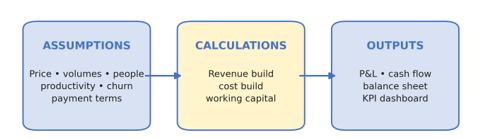
Build your model up from assumptions, calculations to outputs
Assumptions should sit in one place. Calculations should be driven by those assumptions rather than hard-coded across every month (never ever do this). Outputs should include a linked P&L, cash flow, balance sheet and KPI dashboard.
Get this all lined up from the start and it’s going to help you do everything else. Founders will often build the pitch deck first and then build the model. Please don’t do this.
Build a good model first and the pitch deck writes itself.
Some other brief modelling tips:
- A model should be three years back, or the total company history, and three years forward. These two things should integrate so you can see that the forecasts are realistic.
- Drive revenue through what you can control. Sales headcount, ramp time, quota, win rate, average contract value, churn, expansion, implementation capacity, usage, gross margin, hiring and payment terms. DO NOT hard code in revenue forecasts.
- Don’t hard code numbers. Another great quote (not mine) is “models are like underpants, you only like you’re own”. That means you need to make them super clear. Don’t have any numbers in your model that aren’t explained or appear randomly. Make it auditable.
Investors are not looking for false precision. They are looking for causality. If you hire three more salespeople, what has to happen before revenue appears? If growth slows, what happens to cash? If gross margin is five points lower, when do you need to raise again?
Spend some time on your model and you’ll grow to love it.
ARR: seems to be the hardest word
There is only one formula for ARR:
MRR = recurring revenue live this month
ARR = MRR x 12
The word doing the hard work here is “recurring”
Founders and investors can be surprisingly creative around the word recurring.
Implementation fees, onboarding, consulting, pilots, proofs of concept, pass-through spend and one-off usage spikes have all found their way into numbers labelled ARR.
A pound of services revenue can be valuable. It just does not behave like a pound of recurring software revenue, and it should not borrow the other one’s under pants (second time I’ve used pants in a blog today).
Investors do not hate services. They hate surprises or finding out that software revenues are actually outsourced consultants.
ARR is so important as despite everyone being annoyed by it, ARR performs the shorthand for traction and is almost always the starting point for valuation. The headline number is quick to read. The quality of the number takes a little more work.
The Customer Cube: an ARR diligencers favourite tool
The most useful starting point in most diligence is a Customer Cube: customers down the side, months along the top, and revenue for each customer in each month.
It is one of the least glamorous and most useful documents in a data room. In about 30 seconds, it shows starts, expansion, contraction, churn, seasonality and concentration.

One view: start date, expansion, contraction, churn, seasonality and concentration
From there, take each customer and trace the story: customer data, contract, invoice, cash receipt and the cost of delivering the service. That is diligence in miniature.
If you are selling to consumers or SMBs then you may well run the customer cube in cohorts or customers rather than individual customers, but in principle it works the same.
Now before you scream it; yes usage-based models, like a lot of AI models, need slightly more care. AI and fintech companies increasingly combine subscriptions with tokens, inference, API calls, transactions or take-rate revenue. These can be excellent models, but annualising the best month can produce nonsense. I love ice cream. I would still not multiply August ice-cream sales by 12 and call the result recurring revenue.
Show what is contractually committed, what is variable, the customer-by-customer monthly usage, any seasonality or one-off spikes, and the method used to annualise it. You can then work out patterns in the data. It might be there is clear seasonality that can be applied, or it could be that you take an average of the last 3, 6 or 12 months of usage.
The important part is that you can defend what is recurring and why you expect it next time. Contractual revenue is the gold standard but that doesn’t mean that all other usage based revenue is ignored.
The reality here is that Investors are really good with lots of data so don’t fear giving it to them. And, if you’re worried about commercial sensitivities then in the short-term you can always just anonymise the customers.
CARR: like ARR but not ARR
Founders often say:
“We have signed £X. It is basically ARR.”
Sometimes it is. Sometimes that is a very optimistic use of “basically”.
A useful distinction is:
- ARR: recurring revenue that is live today.
- CARR (Contracted ARR): revenue that is signed in a contract but is not necessarily live, fully deployed or billable yet. It’s waiting for something to get started.
- Pipeline: revenue that may be likely, exciting or heavily discussed…. but is not contracted.
CARR can be a useful leading indicator when the time from signing to go-live is short and historic conversion is reliable. It is less persuasive where rollouts take six to 12 months, contracts contain opt-outs or ramp periods, deployment is subject to budget, or signed deals regularly fail to reach full value.
Do not spend diligence arguing about the acronym. Provide a clean bridge: live today; signed and pending rollout, with expected go-live dates; contractual expansion; and genuine upside. Put the historic conversion rate next to it.
Investors will also read the terms. Cancellation rights, minimum commitments, payment terms, price ramps, reseller rights and side letters can change the economics completely.
The logo is not the contract and a top grade data room will have a whole folder of contracts that tie into the Customer Cube.
Diligence Case Study 1: Round Tripping
Sometimes the issue is not a one-off being labelled recurring. It is that reported growth does not appear to reflect ‘independent’ customer demand. Key word here is ‘independent’.
A plain-English version of “round-tripping” is simple:
- Company A books revenue from Company B.
- Company B books similar revenue from Company A, directly or indirectly.
- Both can appear to be growing quickly, while the underlying economic demand is much weaker than the topline suggests.
In a world where growth matters more than profits this can be a real issue.
Case study: Builder.ai… follow the customer and the counterparty
Builder.ai had raised more than $500 million before entering insolvency proceedings in May 2025. The Financial Times reported that an internal investigation had identified potentially bogus sales, with a provisional 2024 revenue estimate reduced from $220 million to around $55 million and a previously reported 2023 figure expected to fall from $180 million to roughly $45 million. Ouch.
Even where genuine services are delivered, the sensible question is whether each relationship would exist, on the same terms and without the other. That is why investors look for customer–supplier overlap, related parties, rebates, marketing funds, netting arrangements and unusual side letters.
Founders do not need to become defensive about this. Disclose the relationship, show how money moves, explain the commercial rationale and provide the documents. Transparency makes the work faster.
Why cash is always king
Revenue can be recognised before it is collected.
But cash is what’s in the bank and is fact today.
That is why investors compare the P&L with invoices, receivables and bank movements.
If revenue doubles while receivables triple and collections slow, the commercial story has changed…. even if the headline chart still points up and to the right.
Diligence Case study 2: Wirecard. Follow the money (cash)
I wrote about Wirecard in a recent blog and it’s an extreme example. On 22 June 2020, its management board said there was a “prevailing likelihood” that €1.9 billion of reported trust-account cash did not exist. The company filed for insolvency three days later.
Wirecard were doing a lot of less than savoury things. They were doing a bit of round-tripping, but they were also making up essentially fake customers and creating false invoices for services never delivered.
This has had the impact of creating incredible top-line revenue. But how did they explain the cash?
This was the ‘clever bit’ they pretended to buy up other companies using the cash they had supposedly ‘generated’. Usually these companies would be worth much less than they reportedly paid, but they were also in jurisdictions where no one looked too closely and so no one checked they’d actually paid for them.
Perhaps the number one rule in diligence… follow the cash.
So as a Founder the more clear you can be to your investor on the cash movements the happier they’ll be. A startup data room does not need to look like a forensic accounting exercise. But where evidence can come from the source, it should.
Bank statements may seem simple but can be very helpful.
At a practical level, investors will want to understand opening cash, receipts, payments and closing cash; aged receivables; major credits and rebates; payment terms; debt and restricted cash; and whether collections by customer behave as the contracts suggest.
Cash is not the same as revenue. It should, however, behave like the commercial model suggests it will.
Gross margin: where software can become a people business
Even if the revenue is real, repeatable and collected, investors still need to understand what it costs to serve the customer.
Gross margin is used as a rough proxy for scalability. High gross margin suggests that incremental revenue can create incremental profit. Low or unstable gross margin suggests that growth brings a lot of ongoing delivery cost with it (usually people).
With AI companies we’ve seen gross margins come down, at least in the short-term, that’s not necessary a problem if we know what is in those margins and how they will scale up. As inference costs get cheaper so should the margin increase.
Be super clear about what’s in your gross margin:
- Onboarding
- Implementation
- Ongoing Support
- Data labelling
- Managed services
- Cloud and inference costs
- Third-party data
- Payment processing
- Etc Etc
Human involvement is not a problem. A product can combine software and expert delivery very successfully. The problem comes when a people-heavy service is valued and modelled as though the people are not required.
A useful test: which costs disappear if the customer disappears?
That question often gets to the answer faster than a long debate about accounting policy. Separate software, implementation, services and usage revenue where it helps, and build gross margin from the costs genuinely required to deliver and retain each stream.
Does the product actually work
I’ve not gone deep on this topic, as hopefully it’s pretty obvious. Investors care about whether the product actually works because everything else ultimately depends on it!
You can have a great founder, a huge market and impressive early customers, but if the product does not reliably solve the problem it claims to solve, none of that is sustainable.
The key diligence question is therefore not simply whether customers are buying it (we’ve all bought the latest exercise fad only to find that it didn’t give us the required sixpack), but whether it genuinely delivers the promised outcome, consistently and at scale.
That means understanding how it performs in the real world, what happens when things go wrong, and whether customers are getting enough value to keep using and paying for it.
The issue is the Silicon Valley culture is “fake it until you make it”. I’ve one word for that…. Theranos.
Case study 3: Theranos. Fake it until they realise it never worked
Theranos raised more than $700 million from investors and at one point was valued at around $9 billion. The core claim was that it could run a large number of blood tests from only a tiny amount of blood using its own proprietary technology. In reality, reporting by the Wall Street Journal and subsequent regulatory investigations found that many tests were being run on conventional third-party machines and that the company’s own technology was far less capable than investors had been led to believe.
What makes Theranos particularly relevant from a diligence perspective is the calibre of people around the business. Its board included former US Secretaries of State and other highly credible figures, while the investor base included a number of sophisticated family offices and institutions. But very few had deep diagnostics expertise, and the company tightly controlled access to its technology, employees and underlying performance data.
The diligence lesson is simple. If the investment case depends on a piece of technology working, you need to independently test whether it actually works. As Founders help investors by providing customer referrals and the more technical you are expect investors to be asking a lot of questions.
How to make diligence genuinely fast
I’m often asked by Founders “How long will diligence take?”. I tend to point out that speed comes from preparation, not from hoping the investor asks fewer questions.
Below is a summary of what to think about when entering diligence:
- Do you have a financial model – 3 years forward, 3 years back and assumptions driven by what you can control and measure?
- Do you have a customer cube or cohort analysis that ties back to the numbers in the model?
- Are you clear on your ARR definition and what’s actually CARR or something else?
- Have you broken gross margin down in detail and can you defend it?
- Have you got a folder with all your customer contracts that ties back to the customer cube?
- Do you have a pipeline of customers that shows what the near term closes are going to be and the long-term prospects are?
- If your using usage base pricing do you have the data that supports your ARR number?
- Do you have evidence around cash collection and do your bank statements tie back to the financial model?
- What evidence do you have that the product works – expert call or customer references?
If you have all this then chances are diligence will be slick and pretty painless. If not then you’ll just get more and more questions.
Diligence doesn’t need to be absolutely clean, an odd customer contract, someone that churned before they started etc so make sure these are pointed out; you’ll just get questions otherwise.
Final few words
Diligence is not there to slow a founder down. Honest.
It exists because impressive topline numbers can hide one-offs labelled recurring, weak contracts presented as committed revenue, growth that does not convert to cash, and unit economics that rely on hidden labour.
Getting the cheque is not the end of that discipline.
In the next article, I will look at the first 100 days after investment: what a useful board pack looks like, how to set the communication rhythm, and why investors need the bad news while it is still small enough to do something about it.